The Films of Bela Tarr and the Weight of Time
Few filmmakers have transformed duration into such a profound moral and aesthetic experience as Bela Tarr. His films are not simply slow; they are structured around the pressure of time, the heaviness of waiting, and the collapse of certainty. To watch a Tarr film is to enter a world in which movement is never just movement, weather is never just background, and narrative is stripped to the point where existence itself becomes the true subject.
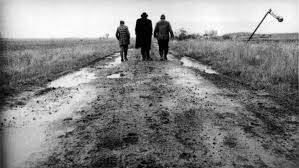
From Damnation to Satantango, from Werckmeister Harmonies to The Turin Horse, Tarr developed one of the most rigorous cinematic languages in modern European film. Long takes are central to this language, but they are not a decorative signature. They are a way of forcing attention. The camera does not rush to explain. It remains with bodies, mud, corridors, drunkenness, fatigue, animals, wind, and faces marked by endurance.
What makes Tarr’s cinema so distinctive is the relation between movement and despair. His characters often continue because there is nothing else to do. They walk, drink, argue, wait, or repeat gestures inside social worlds that seem abandoned by history and promise alike. This does not make the films abstract. On the contrary, they are densely material: rain, coats, smoke, earth, windows, and crumbling buildings all carry equal dramatic force.
Satantango remains the defining monument. Its extraordinary length is inseparable from its vision. The film does not offer duration as a test of patience but as an ethical demand. One begins to understand corruption, illusion, and communal decay only by remaining inside the time of the place. The film’s structure of repetition and return deepens that effect, making every development feel haunted in advance.
Werckmeister Harmonies is perhaps the most immediately accessible of Tarr’s major works, though it is no less severe. Here, apocalypse arrives not through spectacle but through atmosphere, rumor, and collective disorientation. The famous opening sequence already contains Tarr’s method: bodies in a room become a cosmic model, and choreography becomes philosophy. The world is both intimate and catastrophic.
With The Turin Horse, Tarr approached an endpoint. The film seems to ask what remains when action, ambition, and even language begin to dry up. The repetition of daily tasks is not empty; it becomes a vision of exhaustion. The film’s stripped-down severity can feel almost terminal, as though cinema has reached the edge of what it can still show.
Bela Tarr’s place in film history is singular because he refused the acceleration that defines so much contemporary image culture. He trusted black and white, duration, and the density of space. He made films that do not flatter the viewer with speed or closure. Instead, they insist that time is the deepest dramatic medium available to cinema.
That insistence is why Tarr continues to matter. His films remind us that style is not surface. Style is a form of thought, and in his work thought becomes movement, repetition, mud, wind, and waiting. Few directors have made the world feel so desolate and so fully present at the same time.